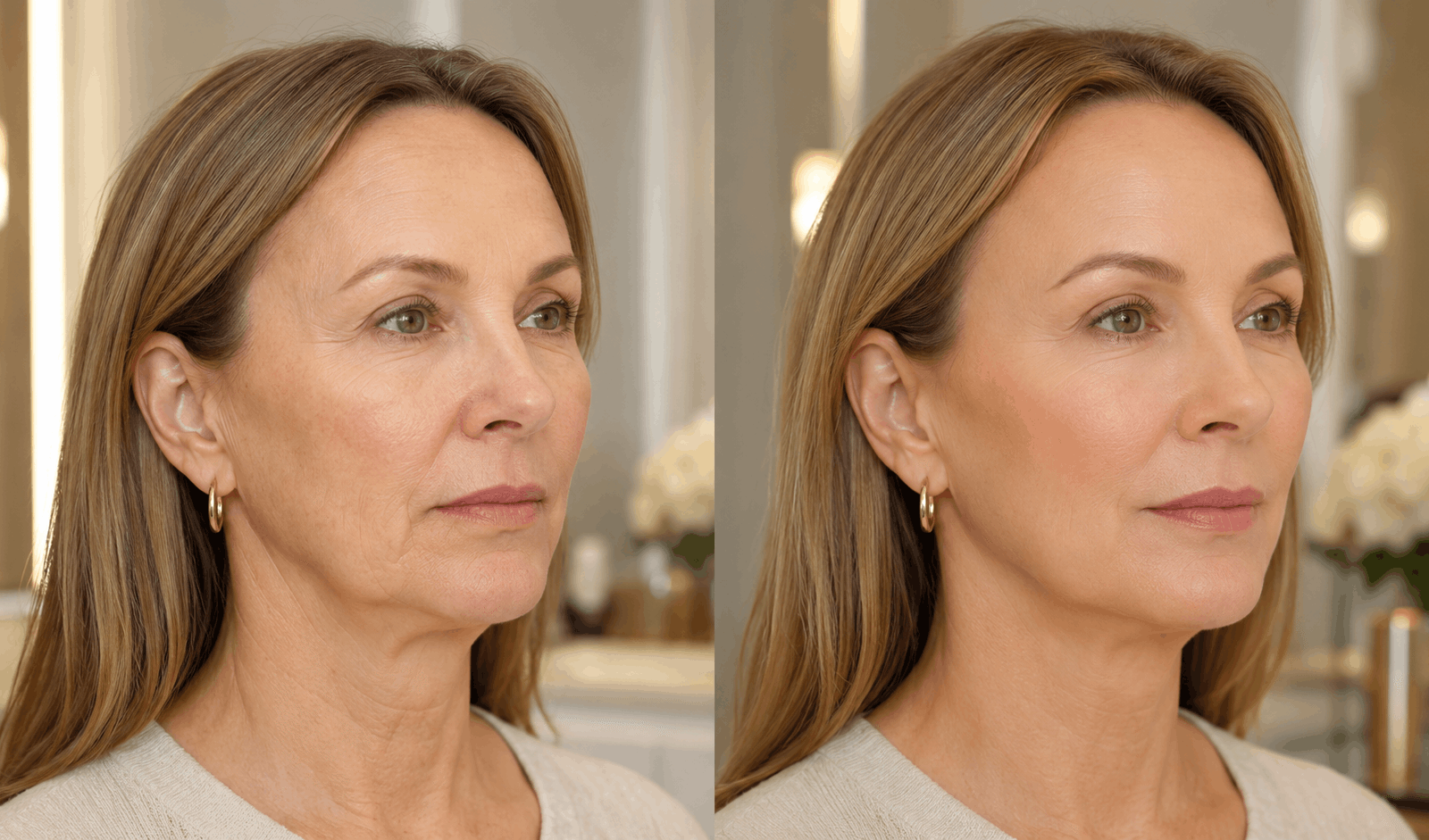
The modern facelift looks almost nothing like the operation people remember from the 1990s. The pulled-tight, windswept appearance that defined that era was a consequence of technique, not aging. Surgeons of that generation tightened skin and called it a lift. Today’s facelift is a structural operation on the SMAS layer (the fibromuscular sheet beneath the skin), and the skin is just along for the ride. The result is a face that looks like you, ten years earlier — not a stretched version of your current self.
Deep plane, SMAS, mini-lift: what’s actually different
The three terms get tossed around online as if they were marketing categories. They’re not. Each refers to a specific surgical depth.
SMAS lift (also called extended SMAS or SMASectomy): the SMAS is plicated or partially removed, then anchored upward. The gold standard for moderate aging changes — jowls, jawline blurring, mid-cheek descent.
Deep plane facelift: the SMAS is released from its underlying attachments and the entire flap (skin plus SMAS as one unit) is repositioned. Better suited to more advanced aging or to patients who need significant midface elevation. Longer recovery, higher technical demand, and not every surgeon should be doing it.
Mini-lift: a smaller-incision variant suitable only for early aging changes, typically patients in their late 30s to mid 40s with limited tissue laxity. Anyone offering a “mini-lift” to a patient with significant ptosis is overpromising.
The neck is half the operation
A facelift without a neck component is, in most cases, a half-finished job. The neck — submental fat, platysmal banding, jawline definition — is where the eye reads age more than the cheeks themselves. A properly planned facelift includes a neck-lift component for the vast majority of patients over 45. Surgeons who treat the face and ignore the neck produce results that look incomplete from the side.
Who is the right candidate
The classic candidate is 50 to 65, in good general health, with moderate jowling, neck laxity, and midface descent. Patients in their 40s sometimes benefit from a limited or “preventive” lift if aging patterns are pronounced. Patients in their 70s can still be excellent candidates if cardiovascular health is solid. Smokers have a much higher complication rate and most surgeons in Cartagena will require 6 weeks of cessation before and after surgery — non-negotiable.
What a facelift does not do
It doesn’t change skin texture, sun damage, or surface wrinkling. It doesn’t restore facial volume — that requires fat grafting, often combined with the lift. It doesn’t lift the brow or treat the upper eyelid; those are separate procedures (brow lift, blepharoplasty). Many patients combine all three for a balanced result, but each does a different job.
Recovery: an honest timeline
Day 1 to 3: bandages, drains, significant swelling. Discomfort is moderate — patients usually describe pressure rather than sharp pain. Day 4 to 7: drains come out, swelling peaks then begins to drop. Day 10 to 14: most patients are presentable in casual settings, though residual swelling and tightness remain. Week 3 to 4: comfortable returning to work for most office jobs. Week 6: light exercise, restaurants, photographs. Week 12: the result begins to look like the final outcome. Full settling and scar maturation takes 9 to 12 months. In Cartagena’s heat and humidity, scar care is a real consideration — sun on the incision lines before month 9 can leave permanent hyperpigmentation.
Scars: where they are and how they fade
Standard facelift scars follow the hairline at the temple, curve down in front of the ear, around the earlobe, and behind the ear into the hairline. A skilled surgeon places the incision in such a way that hair styles, glasses, or simply forward-facing photography hides it almost completely after 6 months. Scar maturation continues for a full year. Silicone sheeting and rigorous sun protection are part of standard post-op care.
Combinations that make sense
Facelift plus neck-lift is standard. Facelift plus blepharoplasty (upper or lower eyelid) is the second most common combination and produces a balanced result. Facelift plus fat grafting addresses both descent (lift) and volume loss (fat) — the most modern approach. Facelift plus brow lift is selectively useful when the upper face has aged in parallel. Combining all of these in a single operation is technically possible but extends OR time and recovery — your surgeon should make a clinical recommendation, not bundle for marketing reasons.
Mistakes we see in revision patients
Pulling the skin instead of lifting the SMAS — a “wind tunnel” appearance that gives away the surgery and fails within 3 to 5 years. Ignoring the neck and producing a face-only result that looks incoherent. Performing a deep plane lift in a patient who only needed a SMAS — longer recovery, no proportional benefit. Combining too many procedures in one session, leading to suboptimal outcomes on each.
Facelift prices in Cartagena (2026)
SMAS facelift with neck-lift: 22 to 32 million COP.
Deep plane facelift with neck-lift: 30 to 45 million COP.
Mini-lift: 14 to 20 million COP.
Add-ons: fat grafting (3 to 6 million COP), upper blepharoplasty (4 to 7 million COP), lower blepharoplasty (5 to 9 million COP).
Prices include surgeon’s fee, anesthesia, accredited surgical suite, drains and dressings, and the standard follow-up package (minimum 5 visits over 6 months). Quotes below these ranges typically reflect a less experienced surgeon or a non-accredited facility. The cost difference between a properly done facelift and a discounted one is small compared to the cost of revision.
Frequently asked questions
How long does it last? A SMAS or deep plane lift “sets the clock back” 8 to 12 years. The aging process continues from there, so the visible benefit holds for 10 to 15 years in most patients.
When can I be in the sun? Hat and SPF mandatory from week 1. Direct beach exposure on the scar lines: not before 9 to 12 months.
Can I fly home in 10 days? Many patients travel internationally at day 10 to 14. Drains must be out, no active bleeding, and ideally one post-op check first.
Will I look different or just younger? The goal of a modern facelift is the second. Patients should be recognizable to their friends — just rested, lifted, and clearly themselves.
The takeaway
A facelift in 2026 is a structural operation, not a skin-tightening procedure. If you’re considering a facelift in Cartagena, the surgeon’s plan should describe specifically which SMAS technique, whether the neck is included, and what combination procedures are recommended — and just as importantly, which ones aren’t needed for your face. That clarity at the consultation stage is the single best predictor of a good result.