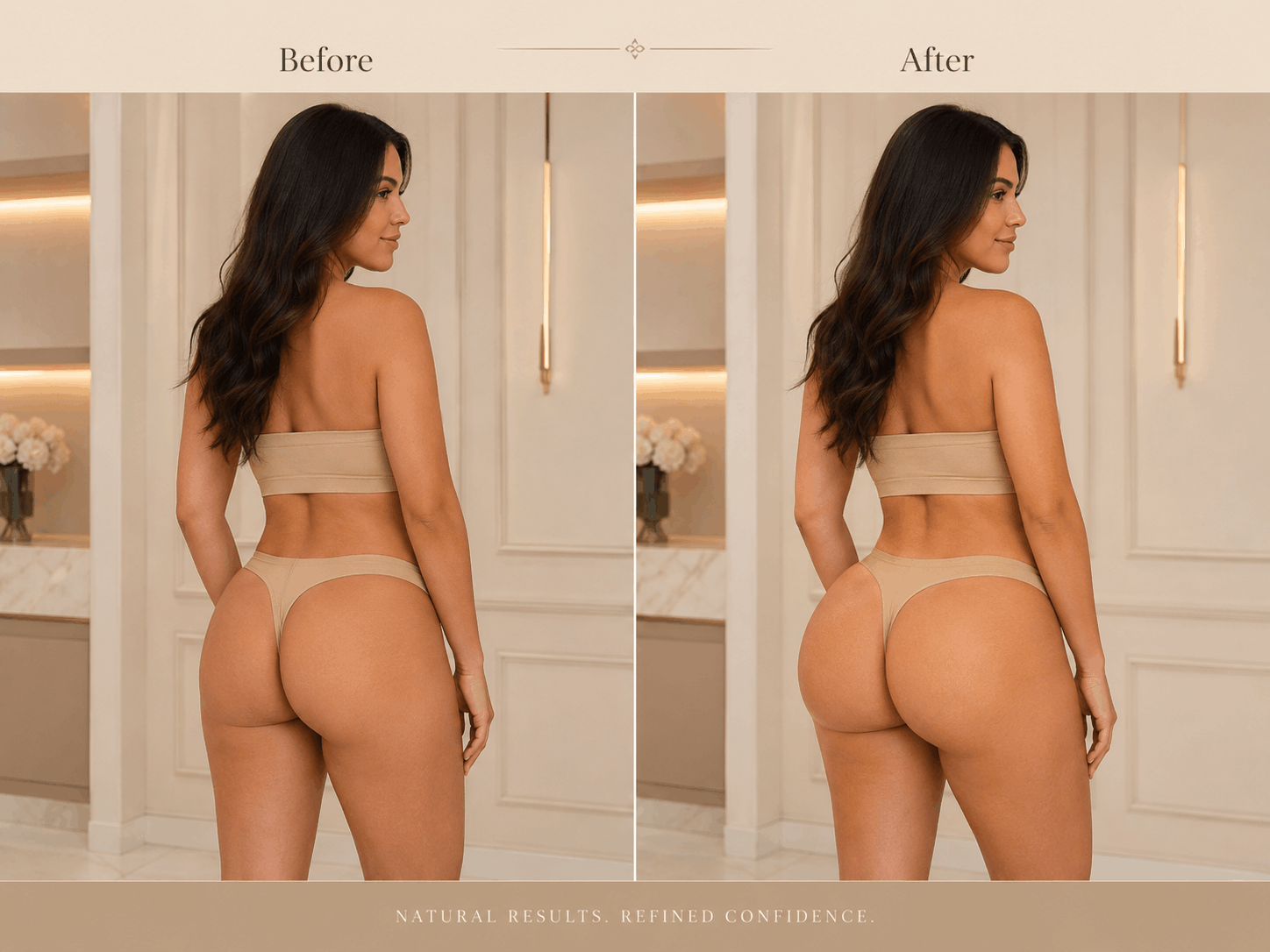
The Brazilian Butt Lift — BBL — is the most-Googled cosmetic surgery in Colombia and the one with the largest gap between marketing claims and surgical reality. Done well, in the right hands, with safe technique, it produces a result that’s been a cultural touchstone of Cartagena and the Caribbean coast for two decades. Done badly, in the wrong hands, it has the highest mortality rate of any aesthetic operation. The difference between those two outcomes is almost entirely about where the fat is placed.
What a BBL actually is
A Brazilian Butt Lift has two parts:
- Liposuction from areas where fat is in surplus — typically the abdomen, flanks, lower back, and bra-line.
- Fat transfer of that purified fat into the gluteal region.
The result reshapes the entire torso. The waist becomes narrower, the lower back curves inward, and the gluteal region gains projection. A well-done BBL changes the waist-to-hip ratio more than the gluteal volume itself — which is why patients often look transformed in profile even when the visible “size” change seems modest.
The safety question — addressed directly
BBL mortality history is real and well-documented. The fatalities reported globally between 2014 and 2018 were almost entirely caused by fat injection into or below the gluteus muscle, which carries a risk of fat entering the inferior gluteal vein and causing pulmonary fat embolism. The international plastic surgery community responded with clear safety guidelines: fat must be placed only in the subcutaneous plane (above the muscle). Modern BBL technique uses ultrasound guidance during injection in higher-risk cases, calibrated cannulas, and a strict no-muscle policy. A Cartagena surgeon who can describe their injection plane technique in detail is a surgeon you can take seriously. One who can’t is not.
How much fat is realistic
The amount of fat that can be safely transferred depends on three things: how much fat you have to donate, how much your tissue can accept without compromising blood supply to the graft, and your overall body composition. Realistic numbers:
- Per side: 300 to 700 cc of fat in most patients.
- Total transfer: 600 to 1200 cc combined.
- Survival rate: 60 to 75% of transferred fat survives long-term; the rest is reabsorbed in the first 3 to 6 months.
Patients who arrive asking for “the biggest possible BBL” should be redirected — the largest transfers don’t produce the best results, they produce the highest complication rates and the most reabsorption.
The waist is half the surgery
Most BBL satisfaction comes from the waist work, not the gluteal volume. 360 liposuction — abdomen, flanks, lower back, and upper back — creates the silhouette that frames the gluteal region. A BBL with insufficient liposuction looks unfinished. A BBL with aggressive 360 liposuction and modest fat transfer looks better than a BBL with massive volume and limited contouring. Your consultation should spend at least as much time on the lipo plan as on the gluteal volume.
Recovery: the demanding part
Day 1 to 3: significant discomfort, sleeping face-down or side-lying only, no sitting except for bathroom use (using a special “BBL pillow” that takes pressure off the grafted tissue), compression garment 24/7.
Day 4 to 7: walking required to prevent clots, lymphatic drainage massage starts (typically 10 to 15 sessions over 4 to 6 weeks), still no direct sitting.
Week 2 to 3: brief sitting with BBL pillow allowed for short periods. Return to office work if you can stand or use the pillow.
Week 4 to 6: gradual return to normal sitting. Light cardio.
Week 8: gym cardio without restriction. Lower-body lifting can wait until week 12.
Final result: visible at month 3, fully settled at month 6.
The sitting protocol is not optional. Sitting directly on the grafted tissue in the first three weeks crushes the fat cells before they’ve established blood supply and reduces the long-term result dramatically.
Caribbean climate considerations
The compression garment is hot and uncomfortable in Cartagena’s climate — but skipping it compromises both the liposuction result (skin retraction depends on consistent compression) and the fat survival (swelling around the graft reduces oxygen diffusion). Most patients use two garments rotating through laundry. Lightweight cotton clothing on top. No sun on the scars (small incisions for the liposuction cannulas) for 6 months.
Combining with other procedures
BBL combines naturally with:
Abdominoplasty: the “BBL + tummy tuck” combination requires careful patient selection because of the prone-to-supine positioning during surgery and the additional anesthesia time. Surgeons who do this combination routinely have good safety records; surgeons who do it occasionally should not.
Breast augmentation or lift: common combination, manageable in one session for healthy patients.
Inner thigh contouring: often included as part of 360 liposuction.
Mistakes we see most often
Choosing a surgeon based primarily on price — BBL is the operation where the savings on a cheap surgeon evaporate completely in the cost of a single complication. Insufficient 360 liposuction, leaving an unbalanced silhouette. Sitting directly on the grafted area in the first three weeks. Skipping lymphatic drainage massages. Sun exposure on the incision sites before 6 months. Going to an unaccredited facility that’s not equipped for emergencies.
BBL prices in Cartagena (2026)
Standard BBL with 360 liposuction: 14 to 22 million COP.
BBL combined with tummy tuck (mommy makeover variant): 26 to 38 million COP.
BBL with inner-thigh liposuction added: 16 to 24 million COP.
Add-ons: lymphatic drainage massages typically included (10 sessions); compression garment included; pre-op labs typically included.
Quotes substantially below this range almost always indicate something missing — non-board-certified anesthesia, non-accredited facility, or a less experienced surgeon. The cost of a BBL complication is measured in months of life disruption, additional procedures, or worse. This is not the operation to economize on.
Frequently asked questions
How long does the result last? The fat that survives the first 6 months is permanent. Significant weight changes (5+ kg up or down) will change the result, as the transferred fat behaves like the rest of your body fat.
Can I sit at all after surgery? Short periods with a BBL pillow that supports your thighs and takes pressure off the gluteal tissue. Directly sitting on the buttocks is restricted for 2 to 3 weeks.
When can I fly home? 10 to 14 days. Long flights require compression stockings, hourly walking, and ideally not in the first week.
Is general anesthesia required? Yes, for any BBL with meaningful liposuction. Sedation-only BBL is a red flag.
The takeaway
A BBL in Cartagena should be planned by a surgeon who can describe their fat injection plane, their volume limits, and their 360 liposuction plan in clear, specific terms. If the consultation moves quickly to “how much” without first discussing “where” and “how”, that’s a sign to look elsewhere. The safe BBL exists — it just requires choosing the right surgeon and the right facility, every time.