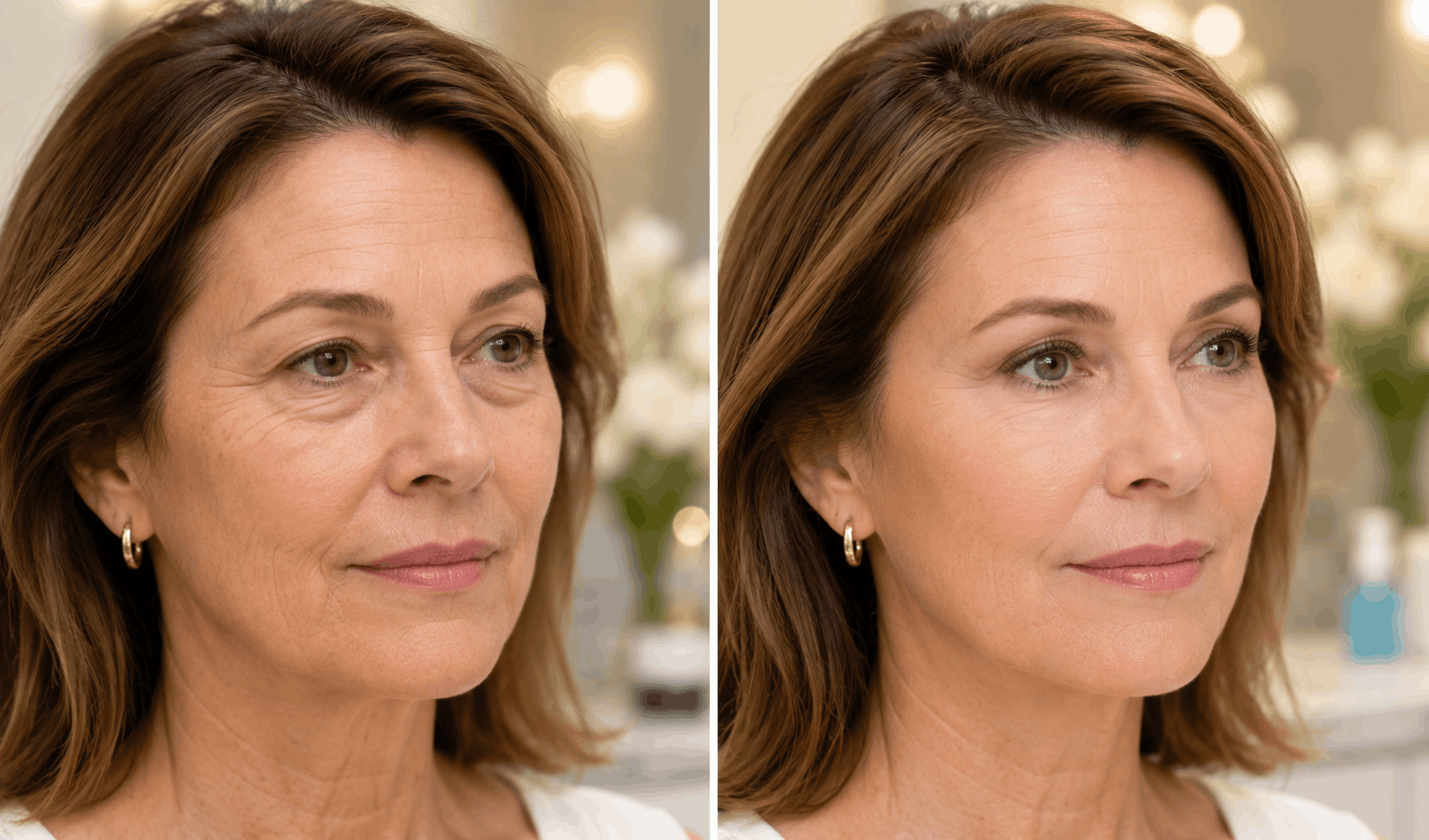
Eyelid surgery — blepharoplasty — is the operation patients most often misjudge. Some are convinced they need it when they actually have a brow problem; others are convinced they don’t need it when their upper eyelid skin is already overhanging the lashes. The eye region ages on three different layers — skin, fat compartments, and the brow position above — and a good surgeon in Cartagena reads all three before reaching for a scalpel.
Upper, lower, or both — what your eyes are telling you
Upper blepharoplasty addresses excess skin and, sometimes, herniated fat in the upper eyelid. The classic candidate has skin that touches or hangs over the eyelashes, makes makeup application difficult, and can even narrow the visual field. Lower blepharoplasty handles fat herniation (“under-eye bags”), excess skin, and the tear-trough hollow. Many patients need only one of the two; some benefit from both done in the same session.
The brow trap
A surprising percentage of patients who come in asking for upper blepharoplasty actually have a descended brow, not heavy eyelid skin. Removing eyelid skin in that scenario pulls the brow further down and creates a tired, more closed-looking eye. Before scheduling upper blepharoplasty, the surgeon should physically lift your brow with a finger and ask “does the upper lid look better now?” If yes, you may need a brow lift, not a blepharoplasty — or a combination of both.
Upper eyelid technique
The incision sits in the natural crease of the upper eyelid and becomes essentially invisible at 3 to 6 months. The amount of skin removed is calculated precisely — too little leaves the original look, too much creates a hollow, surprised appearance. Fat is removed only when there’s clear herniation; preserving fat is the modern approach because the eye region loses volume with age, not gains it. Cases with significant fat repositioning rather than removal produce the most natural long-term result.
Lower eyelid: the harder operation
Lower blepharoplasty is technically more challenging than upper. The lower lid has minimal tissue tolerance for error — over-resection produces “scleral show” (white visible below the iris) or, worse, ectropion (lid pulled away from the eyeball). Modern technique favors:
- Transconjunctival approach (incision inside the lid, no visible scar) for fat-only correction in younger patients.
- Skin-pinch or skin-muscle flap for patients with both fat and skin excess.
- Fat repositioning rather than fat removal whenever possible — moves the herniated fat down to fill the tear trough rather than discarding it.
- Canthal support (a small stitch that supports the lateral corner of the eye) for any patient with lid laxity, which is most patients over 50.
Asian blepharoplasty: a separate conversation
For patients with a monolid or low-set upper-lid crease who want to define a crease (sometimes called “double eyelid surgery”), the operation has different goals and technique. The point is not to look “Western” — it’s to define a crease at a height and shape that suits the individual face. Done well, it preserves ethnic identity and simply opens the eye. Done poorly, it produces a high, harsh, surgical-looking fold. This is a surgery to discuss with a surgeon who does it routinely.
Combining with the rest of the face
Blepharoplasty pairs naturally with:
Brow lift when descent is contributing to the upper-lid heaviness.
Facelift in patients with mid-face aging; balanced rejuvenation usually looks more natural than addressing only the eyes.
Tear-trough filler as an alternative or adjunct to lower blepharoplasty in younger patients with mild hollowing and no fat herniation.
Recovery: visible in two weeks
Day 1 to 3: bruising and swelling, cold compresses every two hours, sleeping at 45 degrees. Day 4 to 7: bruising starts to yellow and fade, swelling drops noticeably. Day 7 to 10: stitches removed (upper lid). Day 10 to 14: most patients are comfortable in social settings, makeup can cover residual color changes. Week 4: full settling of the swelling. Week 8 to 12: scar maturation continues, the crease starts looking entirely natural. Reading and screen work can be uncomfortable for the first 5 to 7 days because the eyes water more than usual — schedule accordingly.
Recovery considerations in Cartagena’s climate
Sun protection on the incision lines is critical. UV exposure on a fresh upper-lid scar before 6 months can leave a darker line that takes years to fade. Sunglasses with UV protection are part of post-op care from day 7 onward. Salt water, chlorinated pools, and air conditioning blowing directly into the face all dry the cornea and should be avoided for the first 2 weeks.
Mistakes we see most often
Removing too much upper-lid skin, leaving a hollow upper eye that looks aged in a different way. Over-resecting lower-lid fat instead of repositioning it. Ignoring canthal support and ending up with ectropion. Doing upper blepharoplasty when the real problem is brow descent. Removing skin from the lower lid in a patient with weak lid tone, pulling the lid away from the eyeball.
Blepharoplasty prices in Cartagena (2026)
Upper blepharoplasty: 4 to 7 million COP.
Lower blepharoplasty: 5 to 9 million COP.
Combined upper and lower: 8 to 14 million COP.
Asian-style upper blepharoplasty: 5 to 8 million COP.
Add-ons: brow lift (4 to 8 million COP), fat grafting to tear trough (3 to 5 million COP).
Pricing includes surgeon’s fee, anesthesia (local with sedation or general depending on case), surgical suite at an accredited facility, post-op kit, and at least three follow-up visits. Beware of quotes from clinics that bundle multiple eyelid procedures at unusually low rates — under-experienced surgeons working with high-volume protocols are common in this category.
Frequently asked questions
How soon will I look “normal” in photos? Most patients photograph well at 2 to 3 weeks. Subtle residual swelling lingers up to 6 weeks.
Does it last? Upper blepharoplasty results typically hold for 10 to 15 years. Lower blepharoplasty is essentially a one-time operation for most patients.
When can I fly home? 7 to 10 days for most patients. Confirm with your surgeon — pressure changes during flight can briefly increase swelling.
Can I wear contacts again? Glasses for the first 2 weeks. Contacts at week 2 to 3 once swelling is down.
The takeaway
Eyelid surgery is a precision operation where millimeters matter. If you’re considering blepharoplasty in Cartagena, find a surgeon who evaluates your brow position, lid tone, and tear-trough anatomy as a complete unit — not someone who quotes “upper lids” before looking at the rest of your face. The eyes are the first thing anyone reads in a face. They deserve the precision.